Safety & rights
AI image copyright: who owns it and how can you use it?
Copyright in AI images depends on how much creative contribution a person made. We explain the position under the U.S. Copyright Office, a court ruling and EU rules, the training-data debate and practical steps.
Zling AI Team7 min read
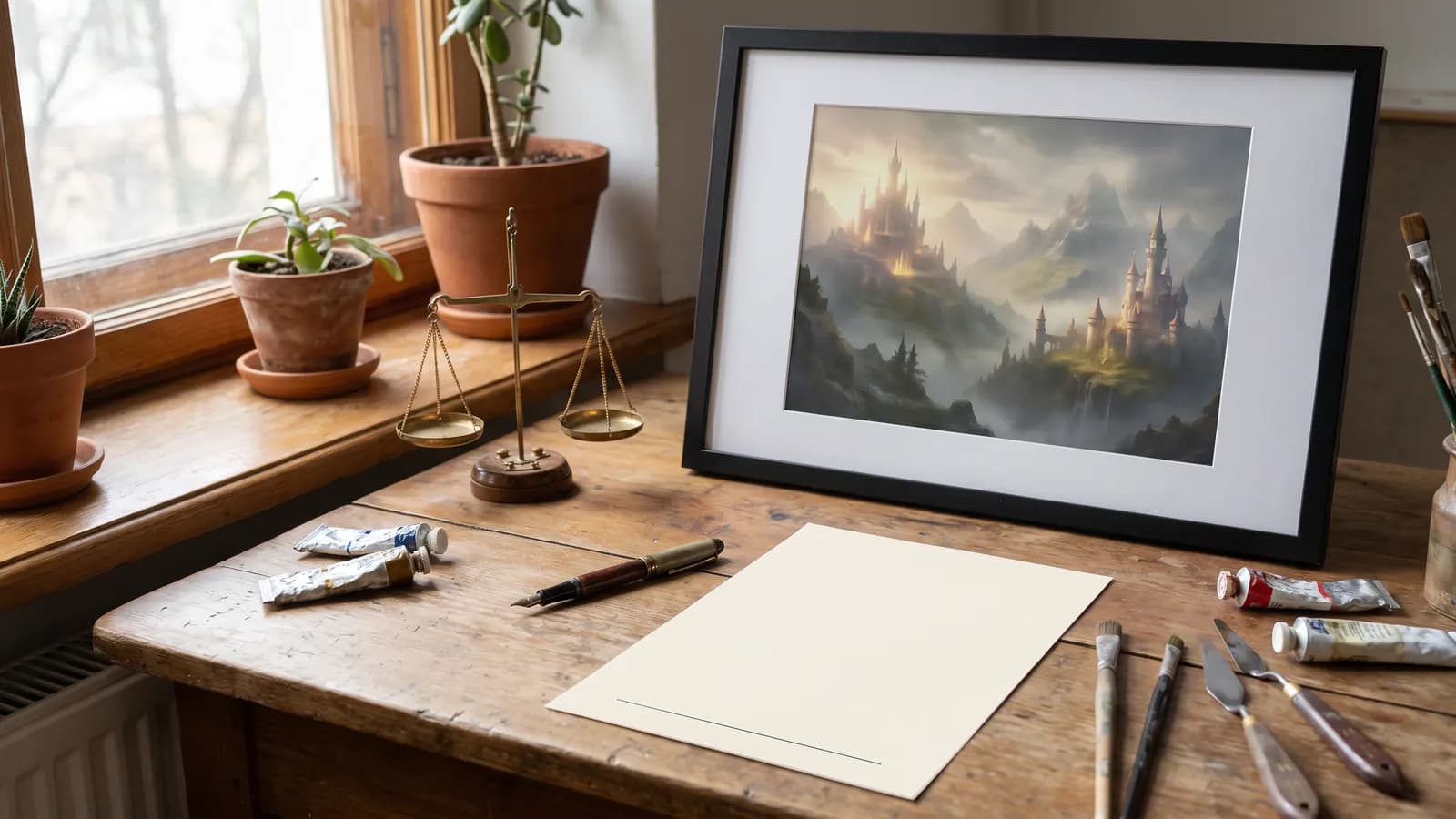
Short answer: the copyright of an AI-generated image generally depends on how much creative contribution a human made to it; according to the U.S. Copyright Office, simply writing a prompt is not enough on its own. Rules differ by country and some questions are not yet answered. This article summarizes the current picture based on official sources. It is not legal advice; for important commercial uses, consult a lawyer.
Who owns the copyright of an AI image?
Most copyright systems look for a work created by a human. In the United States, two sources show this. The first is Part 2 of the U.S. Copyright Office's "Copyright and AI" report (Copyrightability, 29 January 2025). According to the Office's announcement, generative AI outputs can be protected by copyright only where a human author has determined sufficient expressive elements; the mere provision of prompts is excluded. The second is the D.C. Circuit's Thaler v. Perlmutter decision (18 March 2025): the court affirmed the denial of a copyright registration for a work generated autonomously by an AI system. The decision was narrow; it did not answer how much human contribution is needed.
How much human contribution is needed?
The Copyright Office report highlights three points:
- A prompt alone is not enough: the mere provision of prompts does not create copyright.
- A human's creative arrangement or modification can be protected: if a person arranges or modifies the output creatively, that contribution can be protected.
- Using AI is not forbidden: using AI to assist creation, or including AI-generated material in a larger human work, does not bar copyright protection.
The Office also says "the case has not been made" for changing existing law to give AI outputs additional protection. Result: what is protected is your creative contribution, not what the model produced on its own. Exactly where the line falls is assessed case by case.
What is the position in Turkey?
Turkey's Law No. 5846 on Intellectual and Artistic Works defines a work as a product of science and literature, music, fine arts and cinema that bears "the personality of its author", and defines the author as the person who creates the work. The law also recognizes adaptations that are made using other works and bear the adapter's personality, and compilations whose content is made of selection and arrangement. We could not find a provision specific to AI outputs that we can cite, so for how these definitions apply to AI outputs in practice you should ask a lawyer.
What is the training-data debate?
The second big question is what data models are trained on. Part 3 of the U.S. Copyright Office's report addresses generative AI training; according to the Office's page, a pre-publication version was released on 9 May 2025 and a final version is to come later. In Europe two texts stand out. Article 4 of Directive 2019/790 allows people with lawful access to make copies for text and data mining, unless the rightholder has reserved the right in an appropriate manner, such as machine-readable means for content made publicly available online. Article 53(1)(c) of the EU AI Act asks providers of general-purpose AI models to maintain a copyright policy and to respect such reservations. Exactly how a reservation must be expressed is still debated, and courts may assess it differently.
This debate may not concern you directly as a user, but it is good to know that the legal status of training data can affect the terms of the tool you use and future regulation.
Using styles, brands and real people
The points below are general practice and vary by country:
- Output that resembles a specific work: In general, reproducing the protected expression of a specific work by an artist can infringe; producing "in a style" is not the same as copying a specific work. If results come out very close to a specific work, do not use them.
- Brands and logos: Trademark law is a separate area; using a brand's logo or name as if it endorsed your product can cause problems.
- Real people: Using a person's likeness concerns personality rights and personal data. Do not use it without consent, especially commercially. See our article What is a deepfake?.
- Characters and films: Generating images of recognizable characters can touch the rights of that character's rightholder.
What should you do in practice?
- Read the tool's terms: what do they say about commercial use of what you generate?
- Document your contribution: keep prompts, attempts, choices and later edits.
- Make meaningful changes: edit the output, combine it, add your own elements.
- Do not ask for others' works and brands: avoid naming specific artists or brands.
- Get permission from people.
- Consult an expert for important uses: printing, product packaging and advertising.
Prompt to avoid: "Draw a famous cartoon character exactly like a specific poster by a well-known artist."
Safer prompt: "A small lighthouse on a shore at sunset, watercolour texture, soft orange and purple tones."
Three short scenarios
The following is a general reading of the principles in the Copyright Office's report, not a guaranteed legal outcome.
1. You only wrote a prompt
You wrote one sentence and used the resulting image as it was. Under the Office's approach, simply providing a prompt does not create copyright; protection for the image is weak here. Keep in mind that others could generate a very similar image.
2. You selected and edited the generated images
You took several outputs, turned them into a collage and added your own drawing, text and layout. The Office treats a human's creative arrangement or modification of the output as protectable. What is protected is your contribution; the model's own parts may not be protected on their own.
3. You enhanced your own photo or drawing with AI
The Office says using AI to assist creation does not bar protection. The underlying work is yours and is protected to the extent human authorship is perceptible. Still, check the terms of the tool you use and whether the content you upload belongs to you.
These scenarios show why documenting your contribution matters: being able to show which part is yours makes things easier if a dispute arises.
Checklist before you use it
Before using an AI image in your product, advertising or packaging, ask these questions:
- Do the tool's terms allow commercial use, and is a plan or licence needed?
- Does the image contain a recognizable character, logo, brand or real person?
- Does the image resemble a specific work or artist I know too closely?
- Does it matter that I am the only owner of this image, or is it fine if others generate something similar? For brand-identity work such as a logo this can matter a lot.
- Have I documented my contribution: prompts, versions, edits?
- Could the rules of the country where I will use it differ?
If you answer "yes" or "I don't know" to some of these, consulting an intellectual-property lawyer before scaling up the use is a reasonable step.
Common mistakes
- "I wrote the prompt, so I hold every right": According to the Copyright Office, a prompt alone is not enough.
- Assuming the same rules apply everywhere: Rules differ by country and by the tool's terms.
- Generating with an artist's name and selling commercially: This can create legal risk.
- Not documenting your contribution: Proof gets harder later.
- Hiding that it is AI-made: Many platforms and new rules expect disclosure.
Summary
- Copyright generally requires human contribution; according to the U.S. Copyright Office, a prompt alone is not enough.
- A human's creative arrangement and modifications can be protected; using AI does not bar protection.
- In Turkish law the author is the person who creates the work; we found no cited AI-specific provision.
- The training-data debate continues: in the EU there is a text-and-data-mining exception with rights reservation.
- Be careful with styles, brands and people; document your contribution; consult an expert on important work.
Frequently asked questions
Do I own the copyright of an image I generate with AI?
According to the U.S. Copyright Office, AI outputs can be protected only where a human author has determined sufficient expressive elements; the mere provision of prompts is excluded. A human's creative arrangement and modifications can be protected. Rules vary by country.
What did Thaler v. Perlmutter decide?
On 18 March 2025 the D.C. Circuit affirmed the denial of a copyright registration for a work generated autonomously by an AI system. The decision is narrow; it did not answer how much human contribution is required.
Can I use what I generate commercially?
First read the terms of the tool you use; they set the commercial use rights. Third parties' works, brands and real people's likenesses can raise separate rights issues. Consult an expert for important uses.
Could models have been trained on copyrighted works?
This is contested. In the EU, Article 4 of Directive 2019/790 allows text and data mining unless the rightholder reserves the right, and the AI Act asks general-purpose model providers for a copyright policy. The U.S. Copyright Office released a pre-publication report on training.
Are AI images covered by copyright in Turkey?
Law No. 5846 defines the author as the person who creates the work and treats a work as a product bearing its author's personality. We could not find an AI-specific provision to cite; consult a lawyer.
Sources
- U.S. Copyright Office: Copyright and Artificial Intelligence
- U.S. Copyright Office NewsNet: Part 2 Copyrightability report (29 January 2025)
- U.S. Court of Appeals, D.C. Circuit: Thaler v. Perlmutter, No. 23-5233 (18 March 2025)
- EUR-Lex: Directive (EU) 2019/790 on copyright in the Digital Single Market
- EUR-Lex: Regulation (EU) 2024/1689 (Artificial Intelligence Act)
- Mevzuat Bilgi Sistemi: 5846 sayılı Fikir ve Sanat Eserleri Kanunu
Related posts
Safety & rights
What is a deepfake and how can you tell? A responsible-use guide
A deepfake is AI-generated or altered image, audio or video that looks like a real person or event. We explain the harms, how to verify content and what responsible use looks like.
7 min read
Safety & rights
AI and privacy: what happens to the photo you upload?
A photo you upload is generally sent to a provider and processed; retention and training use depend on the policy. We explain what to check and the basics of your GDPR and KVKK rights.
7 min read
Safety & rights
Labelling AI content: the EU AI Act and platform rules
Article 50 of the EU AI Act asks providers for machine-readable marking and deepfake publishers for disclosure. We explain the timelines, platform rules and C2PA content credentials.
7 min read